Infrared Cooker vs Induction Cooker vs Halogen Hob: Which Technology for Which Market
- Share
- publisher
- CHEFF
- Issue Time
- Sep 11,2026
Summary
A practical comparison of infrared ceramic cookers, induction cooktops and halogen hobs from CHEFF, a hob manufacturer in Foshan Shunde, China: how each technology heats, the real differences in efficiency, safety, cookware and electrical requirements, where each one genuinely falls short, the cost structure behind the factory gate, and which export market each type actually fits. Written for importers, project specifiers and OEM/ODM buyers, with a specification checklist and FAQs.

Quick Answer
Infrared (ceramic radiant) cookers heat a glass-ceramic plate with a resistive element, work with almost any flat-bottomed pan and cost the least to build, but they are slower to respond and the surface stays hot. Induction cooktops heat the pan itself with a magnetic field, so they are faster, more efficient and safer to the touch, but they require magnetic cookware and a heavier electrical supply. Halogen hobs are a radiant variant that uses a tungsten-halogen lamp and heats up in seconds, yet the lamp has a finite life, the zone is small, low-power simmering is harder to hold and the technology has largely been superseded in built-in hobs. For most export markets the honest answer is: induction for premium and hospitality, infrared ceramic for value-driven markets with mixed cookware, and halogen only for niche or portable single-zone products.
How Infrared, Induction and Halogen Actually Heat
The three technologies are often grouped together because they all use a black glass-ceramic panel and touch controls, but they are physically unrelated. Understanding where the heat is generated explains almost every practical difference a buyer will notice in the field.
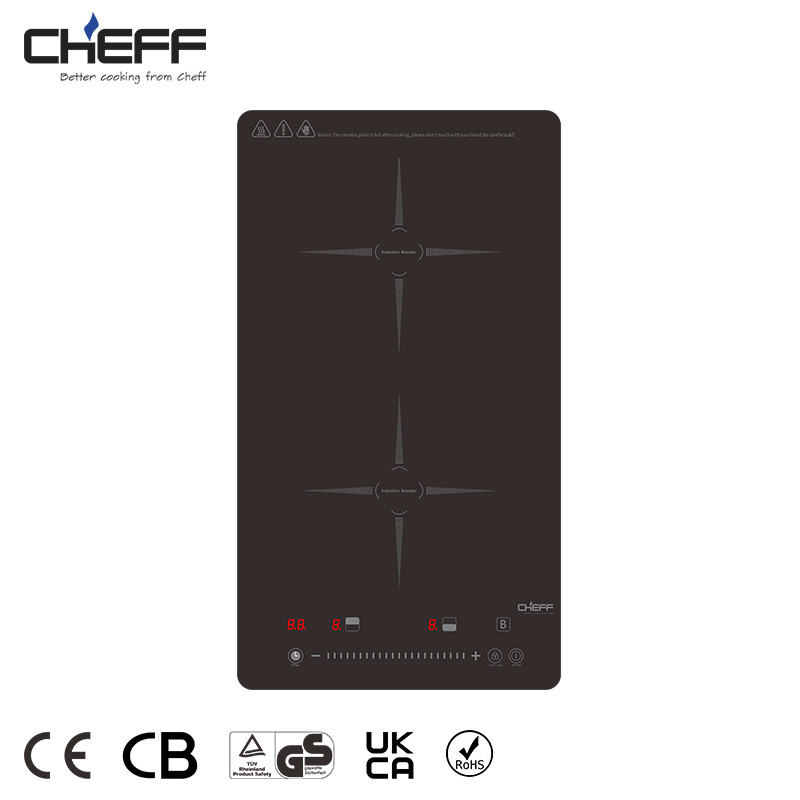
Induction does not generate cooking heat in the hob at all. A copper coil under the glass is driven by a high-frequency inverter, typically in the 20-40 kHz range, which creates an alternating magnetic field. That field induces circulating eddy currents in the ferromagnetic base of the pan, and the pan base itself becomes the heating element. The glass panel stays comparatively cool because it is not being heated directly; the heat you feel on the surface is heat radiated back by the pan. This is why an induction hob responds within seconds and why the surface temperature is so much lower than on a radiant hob.
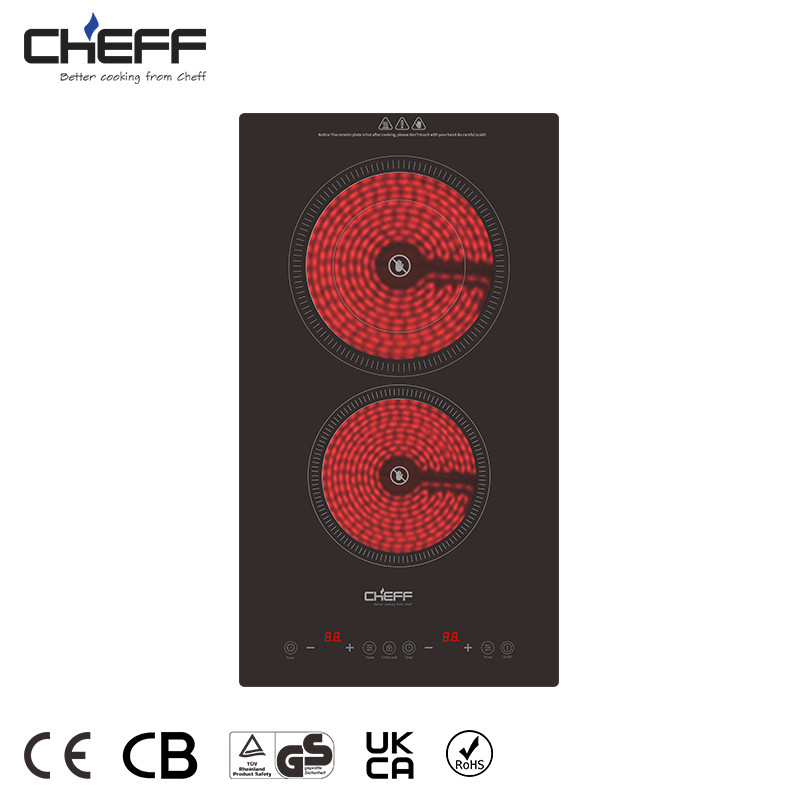
Infrared ceramic hobs are the direct descendant of the classic electric hotplate, refined. A resistive heating element, usually a spiral or ribbon wire in a thermal-insulated housing, sits immediately below the glass-ceramic plate and radiates in the near-to-mid infrared band. The glass absorbs that radiation and becomes hot, and heat reaches the pan mainly by direct contact with the glass plus some radiated energy from the element. The element itself is hot pink in use, and the glass surface reaches very high temperatures. Because the transfer is thermal rather than electromagnetic, the material of the pan base is almost irrelevant.
Halogen hobs are a subset of radiant cooking. Instead of a wire element, a sealed tungsten-halogen lamp or quartz tube sits below the glass and emits visible light together with infrared. The lamp reaches working temperature in a second or two, which gives an immediate glow and a fast start, and the radiant energy heats the glass and then the pan base. There is no inverter and no magnetic coupling, so the pan requirement is the same as for infrared ceramic. The difference is concentrated in the light source: a lamp is a consumable with a finite rated life, and one lamp illuminates one relatively small zone.
Manufacturer’s note: When a buyer says “infrared cooker”, they sometimes mean a radiant glass-ceramic hob and sometimes a gas hob fitted with an infrared burner. Those are different products with different test standards. CHEFF builds both, so we always confirm which one is intended before quoting.
The Three Technologies Side by Side
The table below is the comparison we send to importers who are deciding what to put in a catalogue. It reflects what we see on our own production lines and in dealer service data, not laboratory best cases.
| Factor | Induction | Infrared Ceramic | Halogen |
|---|---|---|---|
| Heating principle | Magnetic induction, heat generated in the pan base | Resistive element radiating infrared through glass-ceramic | Tungsten-halogen lamp radiating light and infrared |
| Cookware required | Magnetic base only; aluminium and copper need an induction layer | Any flat-bottomed pan, including aluminium, copper and clay | Any flat-bottomed pan, same as infrared |
| Heat-up speed | Fastest; a pan of water boils in roughly half the time of radiant | Slowest; glass and element must heat before the pan does | Very fast first response, then limited by the glass |
| Power control | Continuous, fast and repeatable; good for delicate sauces | Cycles the element on and off; slower to correct overshoot | Hardest to hold at low power; lamp cycling is coarse |
| Surface temperature | Cool where no pan is present; residual heat from the pan | Very hot, including outside the pan; long cool-down | Very hot; the lamp area glows visibly |
| Energy efficiency | Highest; most of the field energy ends up in the pan | Lower; a share of the radiation misses the pan | Lowest of the three in normal use |
| Consumable parts | None in normal service; electronics are the critical item | None in normal service; element is the critical item | The lamp itself, which has a rated life |
| Build cost | Highest; inverter, coil, filtering and thermal design | Lowest of the three; simple power electronics | Low, but the lamp assembly adds a service cost |
Read the table as a set of trade-offs rather than a ranking. Induction wins on speed, control and running cost; infrared wins on cookware tolerance and purchase price; halogen wins only on the first few seconds of heat-up, and pays for that with lamp life and coarse control.
Efficiency: What the Numbers Really Mean in a Kitchen
Efficiency figures are quoted loosely in marketing, so it is worth being precise about what is being measured. The useful number is how much of the electrical energy drawn at the socket ends up as heat inside the food, not how hot the hob looks.
Induction is the clear leader because the pan is the heating element. Losses are limited to the inverter electronics, the coil, and the small share of the field that does not couple into the pan base. In normal domestic use this means most of the energy bought at the meter ends up in the pot, and it is the reason a 2 000 W induction zone can out-perform a nominally stronger radiant zone.
Infrared ceramic sits in the middle, and its efficiency depends heavily on how the pan is used. Energy that radiates from the element past the side of the pan is lost to the kitchen, and the glass itself holds a significant thermal mass that must be heated before any cooking happens. A pan that is smaller than the marked ring is the single most common cause of wasted energy on an infrared hob, and it is also the most common cause of dealer complaints about “slow” cooking.
Halogen is the weakest of the three across a whole cooking session. The initial heat-up is dramatic, but a lamp radiates in a narrow beam over a small area, much of that energy bypasses the pan, and holding a low simmer means cycling a high-intensity lamp on and off rather than reducing a continuous flow of heat.
There is a second efficiency that never appears on a datasheet: the kitchen ventilation load. A radiant hob, infrared or halogen, releases meaningful heat into the room even when the pan is oversized, and in hot climates that heat has to be removed by air conditioning. In projects that are engineered on total energy cost rather than appliance price, this often closes part of the gap between a cheap radiant hob and a more expensive induction unit.
Featured Product

Five-Zone Built-in Induction Cooktop — OEM / ODM for Home Cooking
Copper coil induction heating, black ceramic glass, touch control and multiple zone layouts. Voltage, power steps, frame and branding can be tailored to your market.
Safety: Surface Heat, Pan Detection and Residual Heat
Safety on a hob is about three separate things, and buyers routinely conflate them: the temperature of the surface a hand might touch, the behaviour of the appliance when no pan is present, and what happens when something boils over.
Induction is the safest of the three on surface temperature and on unattended operation. With no compatible pan on a zone, the field has nothing to couple into, so the hob draws essentially no cooking power and most models simply switch the zone off after a short period. There is no flame and no glowing element. The residual risk is the pan itself, which is hot in the ordinary way, and the fact that a thin aluminium utensil left on a zone will not be heated at all, which occasionally confuses users rather than hurting them. Users with implanted medical devices should follow the guidance issued for their device and the manufacturer’s instructions.
Infrared ceramic hobs heat their own glass, so the surface remains hot after the pan is removed and after the zone is switched off. Every serious model shows a residual-heat indicator, and the cool-down time is measured in minutes, not seconds. This is the safety consideration that decides location in many projects: a radiant hob is a poorer choice than induction for a kitchen island where children can reach across, and a better choice in a property where users are familiar with electric cooking and expect the surface to stay warm.
Halogen shares the residual-heat profile of infrared ceramic, and adds a bright visible light source that can be uncomfortable at eye level on a low countertop or in a dark open-plan kitchen. Boil-over behaviour is also worse in practice, because the lamp cycles at high intensity and a spill on the glass will bake directly onto a hot lamp area.
Manufacturer’s note: Safety claims are only meaningful against a test standard. For European destinations the relevant framework is the EN 60335 series for household appliances together with the local compliance route; for North America the UL/ETL route applies. When you compare quotations, compare the compliance evidence behind them, not the adjectives.
Cookware: The Hidden Cost of Induction
Induction’s one real limitation is not the appliance at all; it is everything already in the kitchen. A pan must have a magnetic base to heat. Stainless steel and cast iron usually qualify, pure aluminium and copper do not, and many ceramic or clay vessels only work if they are sold with an induction plate built in. In an export market where the household already cooks in thin aluminium, an induction hob can be a product that works perfectly and still disappoints, because the customer’s existing pans are the wrong material.
This single fact reshapes product strategy. A brand selling into a market with an established induction culture, where stainless and cast-iron cookware is normal, can lead with induction and treat cookware as a solved problem. A brand selling into a market where aluminium dominates has to either bundle an inexpensive induction-ready pan, supply an interface disc, or accept that the value tier of the catalogue will be infrared ceramic.
Infrared and halogen have no such constraint, and they also tolerate the wider, thinner pans common in value cookware sets. That is a genuine advantage, and pretending otherwise would be dishonest. What they cannot do is match induction on pan-to-pan consistency: on a radiant hob, a warped or very thin pan base will produce hot spots and uneven results, while an induction zone heats by field strength and is far less sensitive to base flatness.
For buyers who want induction to do more of the work in the kitchen, our earlier guide to smart induction cookers and how connected control is changing modern kitchens looks at where the category is heading in the premium tier.
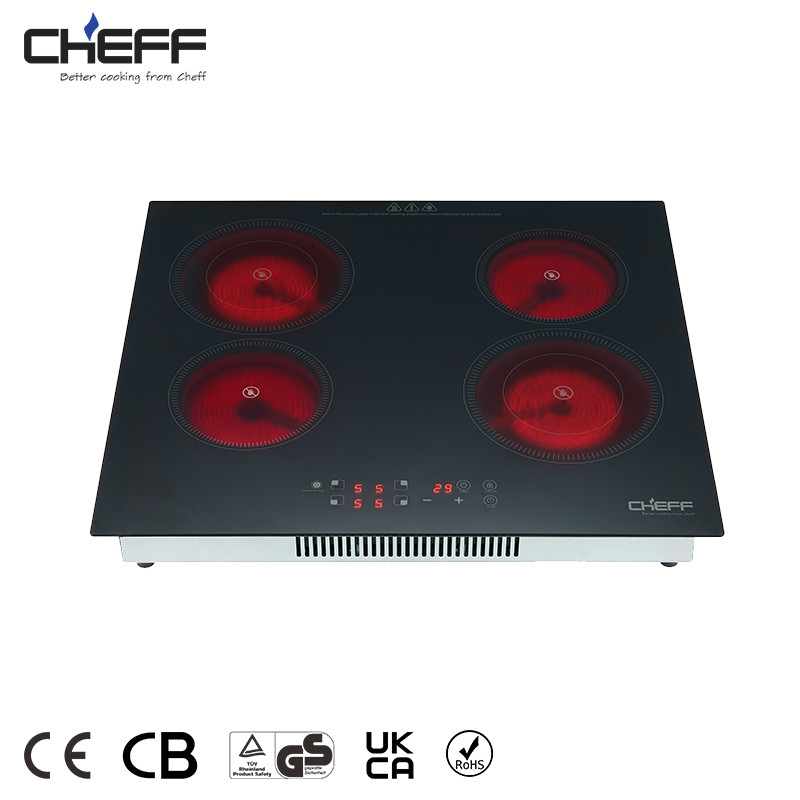
Value Tier
Four-Zone Built-in Infrared Ceramic Hob — 35 inch, OEM / ODM
Radiant elements under a microcrystal glass panel work with aluminium, stainless, copper and clay pans. Simple electronics, low unit cost and broad market tolerance.
Halogen Hobs: Where They Still Win and Where They Do Not
Halogen deserves a fair hearing rather than a write-off. Its advantage is real: a halogen lamp reaches cooking temperature almost immediately, so the zone is visibly working within a second and heating starts faster than on a wire-element ceramic hob. For a portable single-burner product sold on the promise of instant heat, that is a legitimate selling point, and it remains the reason halogen survives in the portable segment.
The problems show up over the life of the appliance, not in the showroom. A lamp is a consumable with a rated service life, so a halogen hob will need the light source replaced while an induction or infrared hob generally will not. The glowing zone is small relative to the pan, which makes even heating harder to achieve across a large cooking vessel. Low-power control is coarse, because the way to reduce output is to interrupt a high-intensity source rather than throttle it, and that is exactly the mode a home cook uses most for sauces, reductions and keeping food warm.
The result is a technology that has largely been displaced in built-in four- and five-zone hobs. Where a buyer today wants radiant cooking for cookware tolerance, infrared ceramic does the same job with no consumable lamp, better low-power control and a lower service load. That is the configuration CHEFF manufactures, and it is why our own export range is built around induction and infrared ceramic rather than halogen. We would rather say that plainly than pretend to offer a full halogen line.
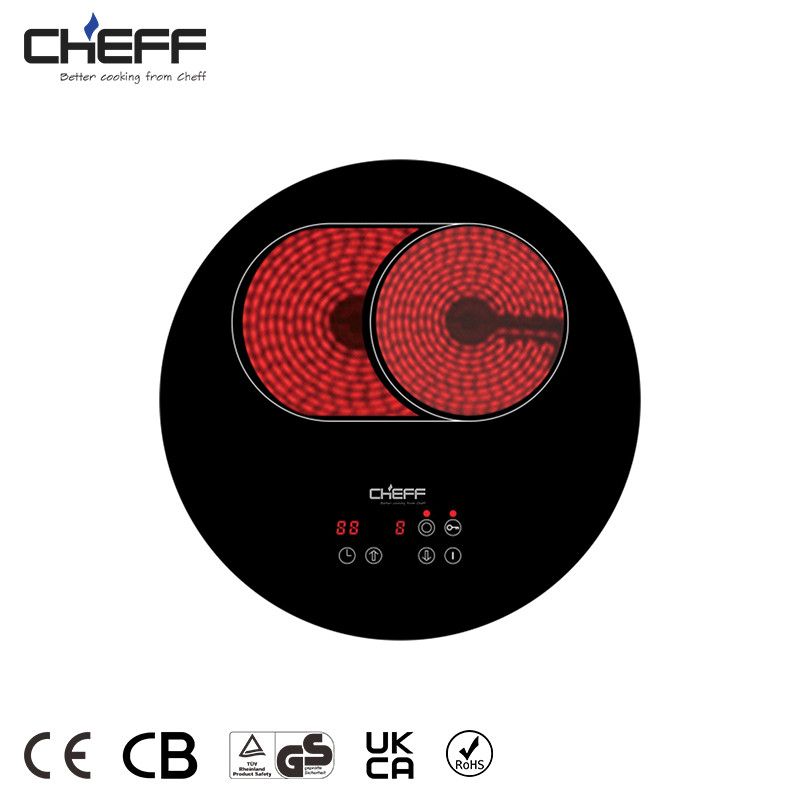
One honest note on terminology, because it causes confusion in tenders. “Light wave” and “halogen” are often used interchangeably in retail listings, and both are radiant products. If a specification demands a halogen lamp source, ask the supplier to confirm the light source in writing, since no amount of infrared radiant heating will satisfy a test that looks for a lamp.
Matching the Technology to the Market
The right technology is decided by four facts on the ground: what pans are already in the kitchen, what the electrical supply can actually deliver, what the retail price tier can absorb, and who will service the product after the sale. Marketing preferences follow those facts rather than leading them.
| Market profile | What shapes the decision | Best-fit technology |
|---|---|---|
| Western and Northern Europe | 230 V supply, strong induction culture, stainless and cast-iron cookware, high energy awareness, strict compliance documentation | Induction for premium and new-build; infrared ceramic only as an entry tier |
| North America | Split 120 V and 240 V circuits; a plug-in induction hob on 120 V is power-limited; retrofit market is large | 240 V induction for new kitchens; infrared ceramic and portable units for retrofit |
| South and Southeast Asia | 220-240 V with frequent voltage sag, aluminium cookware is the norm, price sensitivity is high, service networks are thin | Infrared ceramic as the volume product; induction for the urban premium tier |
| Middle East, Africa, Latin America | Mixed cookware, high ambient temperatures, gas still dominant, radiant electric seen as a robust upgrade | Infrared ceramic for volume; induction for hospitality and premium residential |
| Hospitality and commercial kitchens | Precise, repeatable control, no open flame, reduced ventilation load, high duty cycles | Induction, in multi-zone and higher-voltage layouts |
| Portable and single-zone retail | Low price, small footprint, immediate visual feedback at point of sale | Single-zone infrared ceramic; halogen only where instant glow is the selling point |
Two consequences are worth stating out loud. First, a single catalogue rarely serves every market well; the brands that succeed in mixed regions usually run two tiers, an infrared tier for volume and an induction tier for margin. Second, grid quality matters as much as nominal voltage. Induction electronics are far less tolerant of sustained undervoltage than a simple resistive element, and in markets where supply dips are routine this is a service-rate issue, not a theoretical one.
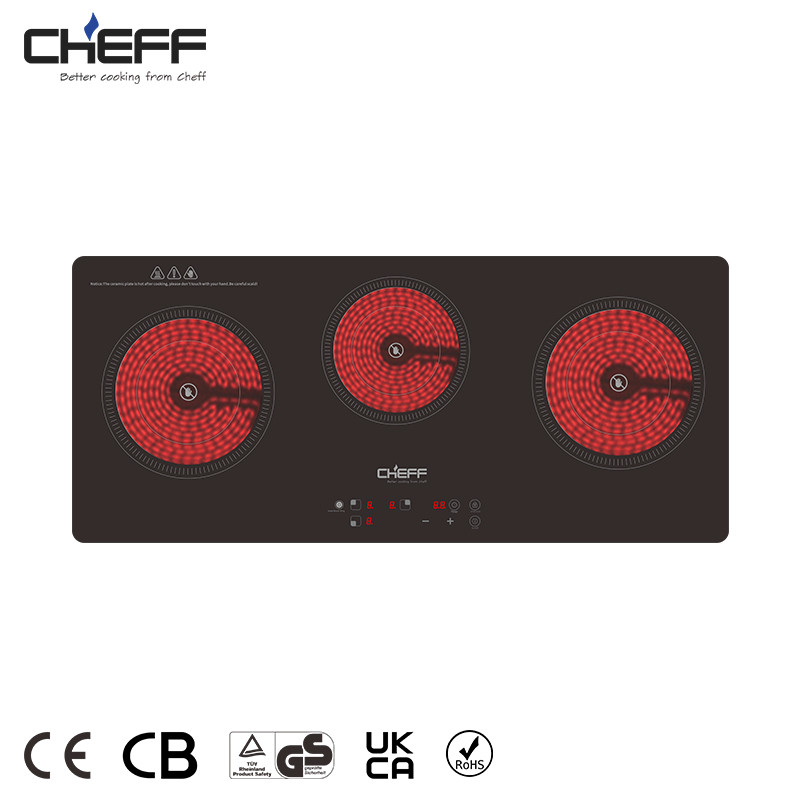
Zone count follows the same logic. A two-zone infrared unit is a natural first purchase in a value market, while a four- or five-zone induction unit is what a premium kitchen or a hotel project specifies. Our own range spans single-zone radiant units at 2 200 W through to five-zone induction and five-zone infrared cooktops rated at 6 500 W, and the zone layout, power split, control logic and branding can all be configured for a specific market.
Cost Structure: Unit Cost, Installation and Service
Purchase price is the least interesting number in this comparison, because the three technologies differ most in where the cost sits over the life of the product.
Induction carries the highest bill of materials. The high-frequency inverter, the induction coils, the EMC filtering, the heat-sinking and the more demanding thermal design all add cost, and so does the engineering effort needed to make the electronics survive years of kitchen heat. In exchange, the product justifies a higher retail price and often earns the brand a better margin per unit. The service profile is dominated by the control board and by airflow: a hob starved of under-counter ventilation will fail early regardless of who built it.
Infrared ceramic is the cheapest to build. The power path is simple, the electronic content is modest, and the parts are long-established and widely available. The consequence is a lower retail price and a lower margin in absolute terms, so the business only works at volume with disciplined quality control. Service is dominated by the element and the glass panel, and glass breakage in transit is a packaging problem that costs more than most component failures.
Halogen is cheap to build but not cheap to own. The lamp assembly adds a wear item, and in markets with a weak service network a failed lamp becomes a customer who does not buy the brand again. That asymmetry, more than raw efficiency, is why halogen has retreated to the portable tier.
Installation cost runs the opposite way to unit cost. Induction and infrared hobs of the same zone count generally share the same cut-out and ventilation discipline, so specification effort is comparable; the difference is electrical. A four-zone induction hob needs a dedicated high-current circuit, and in retrofit markets the cost of running that circuit can exceed the price of the appliance. Radiant hobs draw heavily as well but tolerate poorer supply more gracefully, which reduces the frequency of call-backs in markets where the building wiring is older than the kitchen.
Where Each Technology Falls Short
We build and sell these products, and we would rather a buyer knew the limitations than discovered them at the jobsite or in the returns report.
Induction, honestly: it cannot heat non-magnetic cookware, and it will not help a customer whose kitchen is full of thin aluminium pans. It needs a strong, stable electrical supply, and the electronics are the part most likely to fail if the installation ignores airflow. It can produce audible hum from the coil and fan noise in hard-working models. It requires pans with a flat, adequately sized base, so traditional round-bottomed woks are out unless a dedicated induction wok zone is specified. And because the pan is the heater, a badly warped pan will still cook unevenly, even though the field itself is uniform.
Infrared ceramic, honestly: it is slower, it holds heat in the glass, and its surface stays dangerously warm after use. A pan narrower than the marked ring wastes energy to the room, and a warped or very thin pan base will produce hot spots. Low-power simmering is coarser than induction because output is controlled by cycling the element. The glass is vulnerable to impact and to sugar or salt spills that are left to bake on, and cleaning a hot radiant surface is a genuine inconvenience that customers notice within the first week.
Halogen, honestly: the lamp is a consumable, the heated area is small, low-power control is the worst of the three, and the visible glow is as much a liability in a kitchen as a feature in a showroom. Spare-lamp availability over a five-year horizon is a real risk for a brand that has committed to a halogen line.
Set against those limits, the strengths are real too. Induction is unmatched on speed, precision and safety at the surface. Infrared ceramic is unmatched on cookware tolerance, supply robustness and purchase price. Halogen has one genuine advantage, which is the speed of its first response, and that is worth having only in the narrow product categories where it is the reason to buy.
Specification Checklist Before You Place an Order
This is the list of questions we ask an importer before we quote, and the answers usually settle the technology question within a few minutes.
| Item | Why it decides the specification |
|---|---|
| Prevailing cookware in the market | Aluminium-heavy markets point to infrared ceramic; stainless and cast-iron markets can lead with induction. |
| Actual supply voltage and stability | Determines whether the 120 V, 220-240 V or 380 V version applies and how robust the electronics must be. |
| Zone count and power split | Drives the cut-out, the total connected load and the cabinet and wiring plan. |
| Cut-out and under-counter airflow | The most common cause of early failure in induction; must be planned before the countertop is templated. |
| Glass panel and frame finish | Decides the look of the range and the packaging cost; also the highest-risk item in transit. |
| Control interface and language | Touch layout, icon set and any connected features must be agreed before tooling. |
| Compliance route for the destination | EN 60335 for Europe, UL or ETL for North America; evidence must be requested in writing. |
| Service and spare-parts plan | Decides whether a consumable-lamp product is acceptable in the destination at all. |
If you send a factory your market, your target retail price and a photograph of a typical pan from that market, a competent supplier should be able to tell you which technology fits without seeing a catalogue. If the answer is the same for every market, the advice is not being tailored to the market.
Frequently Asked Questions
Q1. Is an infrared cooker the same thing as an induction cooker?
No. An infrared ceramic cooker heats a resistive element that radiates through a glass-ceramic plate, so the glass and the pan both get hot and any flat-bottomed pan works. An induction cooker uses a magnetic field to generate heat inside a magnetic pan base, so the pan must be induction-compatible but the surface stays much cooler.
Q2. Which is cheaper to run, induction or infrared?
Induction is cheaper to run for the same cooking task, because a higher share of the electricity ends up in the food rather than in the room. Infrared hobs also heat the surrounding air, which adds to the ventilation or air-conditioning load in hot climates.
Q3. Why are halogen hobs less common than they used to be?
Mainly because of the lamp. A halogen hob heats very quickly, but the light source is a consumable with a finite life, the heated zone is small relative to the pan, and low-power simmering is harder to control. Infrared ceramic delivers radiant cooking without a consumable lamp, and induction is faster and more efficient still.
Q4. Can I use aluminium pans on an induction hob?
Not unless the pan has an induction layer in its base. Pure aluminium and copper are not magnetic and will not be heated by the field. Aluminium pans work normally on infrared ceramic and halogen hobs, which is a decisive advantage in markets where aluminium cookware is standard.
Q5. Which technology should an importer choose for a value-focused market?
For most value-focused markets with aluminium cookware and variable voltage, infrared ceramic is the volume product: lower unit cost, simpler electronics and no cookware restriction. Induction is then positioned as the premium tier for customers who already own induction-ready pans and have a stable supply.
Q6. What electrical supply does a four-zone induction hob need?
It needs a dedicated high-current circuit sized to the total connected load, with the correct voltage version for the destination, and adequate ventilation below the hob. Plan the circuit at the same time as the cut-out, because rewiring an existing kitchen after the countertop is fitted is the expensive part.
Q7. Can CHEFF supply all three technologies?
Our export range is built around induction and infrared ceramic hobs, in single-zone through five-zone configurations, together with built-in gas hobs and table-top cooking appliances. We do not currently offer a halogen product line, and we say so plainly rather than position an infrared model as something it is not.
Conclusion: Start From the Kitchen, Not the Catalogue
Infrared, induction and halogen are not competing versions of the same product. They are three different answers to the same question, and the question is always local: what does this kitchen already own, what does its electrical supply actually deliver, what will the customer pay, and who will fix the appliance in year three? Induction is the best technology on the measures that engineers care about. Infrared ceramic is the best technology on the measures that decide whether a product sells in a value market. Halogen has one narrow advantage and a service liability attached to it.
CHEFF is a kitchen appliance manufacturer in Foshan Shunde, Guangdong, China. We build induction cooktops, infrared ceramic hobs, built-in and table-top gas hobs and commercial cooking appliances, with OEM and ODM support covering zone layout, power configuration, control logic, panel design and branding. Products are function- and safety-tested at our plant before shipment, and we would rather tell an importer that infrared is the right answer for their market than sell them an induction tier that will return as complaints. If you are building a hob range, send us the destination market, the target retail price and a photograph of a typical pan, and we will tell you honestly which technology fits.
Choosing a Hob Technology for Your Market?
Tell CHEFF’s engineers the destination, the target price tier and the cookware your customers already use. We reply with a technology recommendation and a configuration, not just a quotation.