The Rise of Smart Induction Cookers: How IoT Technology Is Transforming Modern Kitchens?
- Share
- publisher
- CHEFF
- Issue Time
- Aug 24,2026
Summary
An IoT-enabled induction cooker uses sensors, real-time data and closed-loop control for precise temperature control, greater efficiency and safer cooking.
Quick Answer
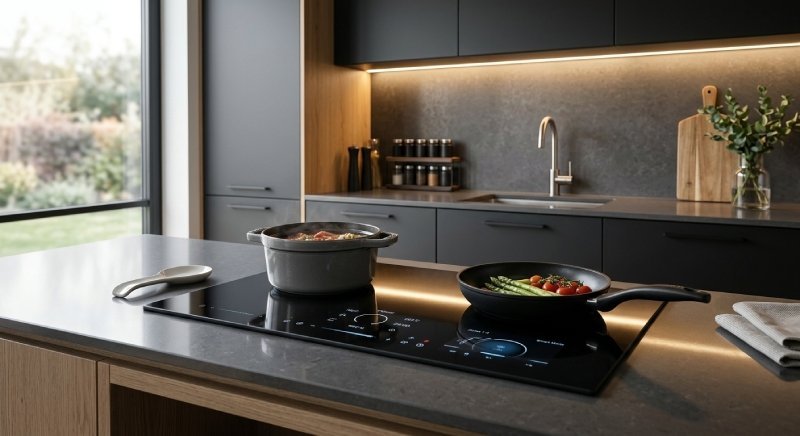
A smart induction cooker is an IoT-enabled appliance that combines sensors, real-time data, and closed-loop control to deliver precise temperature management, improved energy efficiency, and safer cooking through intelligent adjustments.
I have spent the last decade in the kitchen appliance industry, watching induction technology move from simple heating coils into connected systems. If you are searching for a smart induction cooker, dealing with uneven heat, or managing energy and safety in a modern kitchen, you are looking at the same shift I see every day: from basic appliances to smart kitchen appliances that can monitor conditions, process data, and automatically adjust cooking performance.
Smart kitchen trends now favor systems that collect data, analyze conditions, and adjust automatically rather than devices that only respond to a phone app. The real change is the move from connected gadgets to intelligent cooking systems. A smart induction cooker is essentially an IoT-enabled appliance: sensors gather data, the system processes it, and control loops deliver precision, efficiency, and safety.
What Is a Smart Induction Cooker?
A smart induction cooker (or smart induction cooktop) uses electromagnetic fields to directly heat compatible cookware while integrating sensors, connectivity modules, and intelligent control systems. Unlike a traditional unit limited to touch controls, it continuously monitors temperature, power draw, and cookware presence.
Here is a clear comparison:
| Feature | Traditional Induction Cooktop | Smart Induction Cooktop |
|---|---|---|
| Control system | Manual touch or knobs | Sensors + algorithms + app |
| Temperature precision | Fixed power levels | Real-time closed-loop control |
| Connectivity | None | Wi-Fi / Bluetooth / smart home platforms |
| Safety features | Basic auto-shutoff | Detection + remote alerts |
| Energy data | None | Usage monitoring and optimization |
| Automation | Simple timers | Adaptive adjustments |
In short, a traditional induction cooker heats. A smart induction cooker senses, decides, and adjusts. At its core, a smart induction cooker is an IoT appliance built on sensors, data, and control, delivering improved precision, efficiency, and safety for modern kitchen applications.
What Makes an Induction Cooker Truly "Smart"? (Beyond App Control)
Many products call themselves smart because they offer app control. That is only a surface-level feature. Real intelligence is system-level.
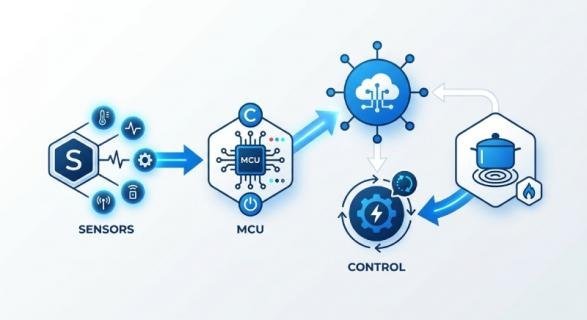
An app lets you turn the unit on or change a setting from your phone. An IoT induction cooktop runs a closed-loop control system: sensors feed live data, the controller processes it, and power output adjusts automatically. This is the difference between a remote switch and true IoT cooking technology.
Four technology layers create a truly smart induction cooking system and IoT-enabled kitchen solution:
- Connectivity — Wi-Fi or Bluetooth links the cooktop to your phone or larger smart kitchen ecosystem.
- Sensor system — Temperature, power, and cookware detection technology supply continuous data.
- Control system — The MCU and power regulation run heating algorithms that keep temperature stable.
- Cloud / AI layer — Usage data supports basic automation and longer-term insights.
When these work together, you get more than remote access. You get consistent results without constant manual correction.
Key IoT Features and Their Real Value
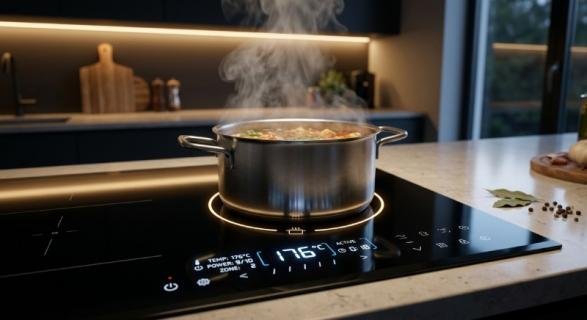
These features translate into daily benefits:
| Smart Induction Feature | Technology Behind It | Practical Value |
|---|---|---|
| Temperature control | Sensors + MCU algorithms | More consistent cooking |
| Cookware detection | Magnetic sensing | Better safety and efficiency |
| Energy monitoring | Data tracking | Lower operational waste |
| Remote alerts | IoT connectivity | Easier supervision |
- Remote control — Adjust or monitor from another room via Wi-Fi.
- Precision cooking — Maintain exact temperatures instead of guessing power levels.
- Safety — Auto shut-off, overheat protection, and alerts when cookware is removed.
- Energy monitoring — Track actual usage so an already efficient induction cooker becomes even more efficient.
The result is measurable control, lower energy waste, and fewer safety risks.
Real User Pain Points Smart Induction Cookers Must Solve
After years of feedback from users, installers, and buyers, the same issues surface repeatedly:
- Power fluctuation and inconsistent heating
- Apps that disconnect, provide limited value, or feel cumbersome
- Touch panels that fail when wet or oily
- Cooling fan noise during operation
- Higher repair complexity
- Occasional cookware detection failures
These are not isolated product defects. They are common engineering challenges as the industry moves from adding smart features to delivering stable, reliable experiences. A well-engineered IoT induction cooktop addresses the root causes through better sensors, algorithms, and firmware rather than more buttons on a screen.
Where Smart Induction Cookers Actually Make Sense?

In each setting the value comes from solving operational needs, not from collecting gadgets.
Residential
Homes that already use smart home kitchen appliances gain convenience and energy visibility.
Rental / multi-unit
Safety features and monitoring reduce risk for landlords.
Commercial
Hotels, restaurants, and catering operations benefit from consistent temperature, energy tracking, reduced training time, standardized cooking processes across multiple locations, and easier equipment management.
Compared with traditional gas cooking, induction offers different advantages in efficiency, safety, and temperature control. Learn more about induction vs gas cooking when evaluating the right cooking technology for different kitchen applications.
Benefits vs Limitations of Smart Induction Cookers
Benefits include precise temperature control, strong energy efficiency, improved safety systems, and the foundation for kitchen automation.
Limitations include higher upfront cost, reliance on network stability for full features, and slightly more complex service needs. The decision depends on how much you value data and closed-loop performance versus pure heating simplicity.
For many buyers, the key question is not whether smart technology exists, but whether it creates measurable improvements in daily operation.
Are Smart Induction Cookers Worth It for Buyers?
For home users who cook frequently or already run a connected kitchen, they can be a valuable upgrade. For distributors, mid-range models with solid IoT performance sell well when positioned against basic induction. For OEM and commercial buyers, the real question is not feature count but long-term reliability.
The value depends less on the number of smart features and more on whether those features solve real operational problems.
How to Choose the Right Smart Induction Cooker?
Look beyond the marketing list. Focus on:
- Connectivity that works with platforms you already use
- Proven temperature stability and sensor accuracy under real loads
- Certifications relevant to your market (CE, CB, ERP, etc.)
- Low noise and durable construction
- Firmware update capability, software stability, and data security
- Supplier capability for OEM/ODM work
In B2B purchasing the decisive factors are rarely the number of app functions. What matters most is system stability, sensor precision, firmware reliability, and the manufacturer's ability to supply consistently over years. Manufacturers such as CHEFF approach smart induction solutions from an engineering perspective, focusing on certification, customization capability, and long-term supply stability.
What Is the Future of Smart Induction Cookers and IoT Kitchens?
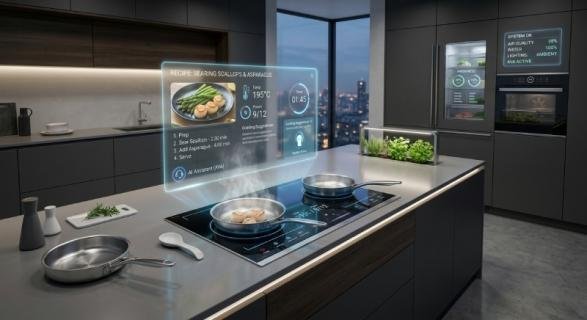
Expect tighter integration with other appliances, more predictive adjustments based on usage data, gradual movement toward autonomous multi-step cooking, and AI-powered cooking assistance. The smart induction cooker will function as one reliable node inside a larger connected kitchen rather than a standalone gadget.
What Is the Difference Between Smart and Regular Induction Cooktops?
A regular induction cooktop delivers efficient, flame-free heat and basic safety. A smart induction cooker adds closed-loop sensing, data processing, and adaptive control. The physics of induction stays the same; the IoT layer changes the consistency, visibility, and total cost of ownership.
Frequently Asked Questions
Q1. What is a smart induction cooker?
It is an IoT-enabled appliance that uses sensors, real-time data, and closed-loop control for precise heating, energy efficiency, and safety.
Q2. How does IoT work in an induction cooktop?
Sensors collect temperature and power data; the controller processes it; the unit connects via Wi-Fi or Bluetooth so you can monitor, adjust, and receive alerts.
Q3. Are smart induction cookers worth buying?
Yes if you cook often, value energy data, or need stronger safety and consistency. Less critical if you only need basic heating.
Q4. What problems do smart induction cookers have?
Common issues include occasional app glitches, higher initial cost, and the need for compatible cookware. Good system design reduces power fluctuation and detection failures.
Q5. Do smart induction cooktops really save energy?
Induction itself is highly efficient. Smart monitoring and precise control further reduce waste by avoiding over-heating and idle power use.
Q6. Can a smart induction cooker work without Wi-Fi?
Yes. Most smart induction cookers can still perform basic cooking functions without Wi-Fi. However, connected features such as remote monitoring, updates, and smart home integration may require a network connection.
Q7. What is the difference between a smart induction cooker and a normal induction cooker?
A normal induction cooker provides efficient heating and basic safety. A smart induction cooker adds sensors, data processing, and closed-loop control for more consistent results, remote visibility, and operational insights.
Conclusion
Smart induction cookers succeed when they operate as reliable IoT cooking systems, not simply as heating surfaces with an app attached. That combination of precision, efficiency, and safety is what makes smart induction technology valuable for both modern homes and professional kitchen applications.