What Is the Best Portable Gas Stove and Fuel for Winter Camping?
- Share
- publisher
- CHEFF
- Issue Time
- Aug 26,2026
Summary
Choose a stove/fuel for winter camping by temperature: isobutane/propane above -10°C; white gas below -15°C. Never use stoves in tents.
Quick Answer
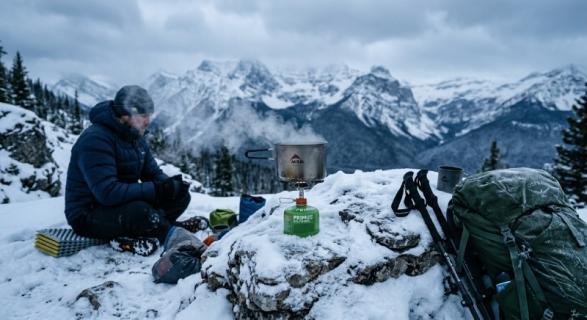
The best portable gas stove and fuel for winter camping depends on temperature: above -10°C, use a regulated canister stove with an isobutane/propane blend; below -15°C or at high altitude, switch to a liquid-fuel white gas stove. Match your stove and fuel to the lowest expected temperature, wind, altitude, and group size—and never use any fuel-burning stove inside a tent or enclosed space.
Temperature, wind, and altitude are the primary variables that determine stove system selection. This is the core framework for winter camping stove choice and selecting the best fuel for cold weather camping.
The decision rules are straightforward:
- Temperature drops: Vapor pressure decreases — switch to a propane-richer blend or liquid fuel.
- Below -15°C or high altitude: Vapor pressure collapses further — use a liquid-fuel (white gas) stove.
- Wind increases: Heat loss accelerates and efficiency drops — choose a stove that accepts a full windscreen.
- Group size increases: Fuel consumption rises non-linearly — prioritize capacity and reliability over weight.
Safety constraint: Always cook outdoors in well-ventilated areas only. Never use any fuel-burning stove inside a tent, vehicle, or enclosed space.
Final selection model: environmental stress (temperature + wind + altitude) + operational demand (group size + cooking load) + risk tolerance = stove system selection.
Why Does a Camping Stove Stop Working in Cold Weather?
This is the most common winter stove failure pattern and the classic case of low temperature stove failure. Many people search “why camping stove won’t work in cold” after experiencing exactly this problem.
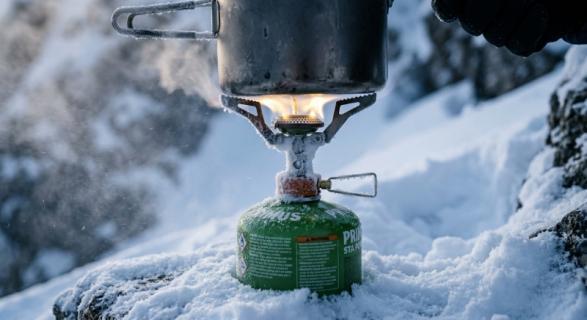
Symptom: The stove won’t light, produces only a weak flame in cold weather, or shows fuel remaining but no usable flame. Users commonly search “stove won’t light,” “weak flame cold weather,” “winter camping stove not working,” and “camping stove fuel but no flame” after this experience.
Cause: Canister fuels are stored as liquid under pressure. The stove needs that liquid to turn into gas fast enough to reach the burner. When temperature drops, vapor pressure falls. Pure butane stops vaporizing near 0°C. Isobutane holds longer. Propane continues much lower. Running the stove itself causes evaporative cooling that further chills the canister—sometimes forming frost—so pressure keeps dropping. Wind accelerates the heat loss.
Result: Fuel still exists inside the canister but becomes unusable. This is not a defect but a vaporization limitation. The flame weakens or the stove simply will not light until the fuel is warmed or a different fuel system is used.
Winter Camping Fuels Explained: Butane, Isobutane, Propane, and White Gas
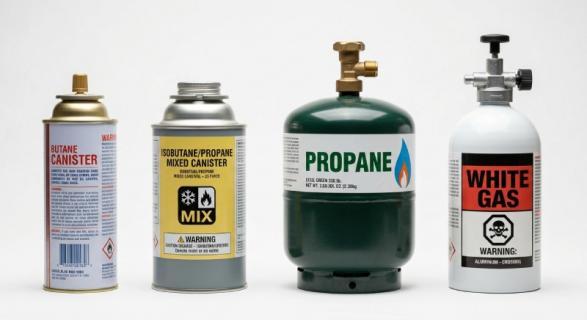
Marketing labels like “four-season” do not guarantee winter performance. Even so-called four-season canisters may still contain high butane content and perform poorly below freezing. Fuel performance is determined by vapor pressure, ambient temperature, and system usage conditions.
| Fuel Type | Temperature Range | Best Use Case | Limitation |
|---|---|---|---|
| Butane | Fails near 0°C | Mild, above-freezing conditions only | Unusable for true winter camping |
| Isobutane | Usable to ~-10°C | Light winter trips when kept warm | Limited for sustained sub-zero use |
| Propane | Reliable well below freezing | Cold-weather reliability, larger cylinders | Heavier cylinders less ideal for backpacking |
| Isobutane/Propane Blend | Practical to ~-5°C to -10°C | Most backpacking winter trips | Still pressure-dependent; can fail in extreme cold |
| White Gas (Liquid Fuel) | Reliable far below -15°C | Extreme cold, snow melting, expeditions | Requires pumping, priming, and more maintenance |
Burner efficiency is also affected by material choice such as brass vs aluminum burner caps, which influence heat distribution and flame stability.
Canister Stove vs Liquid Fuel Stove: Which One Works Better in Winter?
| Factor | Canister Stove | Liquid Fuel Stove |
|---|---|---|
| Cold-weather reliability | Above ~-10°C with warm canister | Below -15°C or high altitude |
| Ease of use | Simple screw-on operation | Pumping and priming required |
| Maintenance | Near-zero field care | Clean jets and maintain pump |
| Fuel efficiency | Shorter or milder trips | Multi-day snow-melting trips |
| Wind performance | Limited windscreen compatibility | Accepts full windscreen |
| System reliability | Lower risk tolerance once pressure collapses | Higher stability, no reliance on vapor pressure |
In winter, reliability matters more than efficiency. Choose based on lowest expected temperature and operational risk tolerance.
What Is the Best Winter Camping Stove for Different Outdoor Scenarios?
Backpacking (Solo)
Recommended stove: Ultralight regulated canister stove
Recommended fuel: Isobutane/propane blend
When it fails: Collapses in strong wind without windscreen or when canister cools on snow. Warm canister thoroughly; carry liquid-fuel backup for critical trips.
Winter Hiking
Recommended stove: Regulated or remote canister stove
Recommended fuel: Propane-rich blend
When it fails: Unregulated upright canisters lose output quickly below -5°C. Insulate and warm canister between uses; improve wind shelter if output drops.
Snow Camping / Expedition
Recommended stove: Liquid-fuel (white gas) stove
Recommended fuel: White gas
When it fails: Canister systems cannot sustain high output for continuous snow melting in extreme cold. Carry extra white gas and a repair kit; groups benefit from higher capacity.
Car / Family Camping
Recommended stove: Stable multi-burner propane stove
Recommended fuel: Propane cylinders
When it fails: Lightweight backpacking canisters become inconvenient for real cooking. Keep a secondary burner or spare propane cylinder ready; prioritize wind-protected setup.
How Much Fuel Do You Need for Winter Camping?
Winter fuel consumption does not scale linearly with temperature or time. It is non-linear and can rise exponentially under combined stress.
- Temperature impact: Colder air and colder fuel increase boil times and total burn duration.
- Wind multiplier: Even moderate wind can double or triple fuel use by stripping heat from the flame and pot.
- Snow-melting multiplier: Melting snow roughly doubles or triples consumption because of the large energy required for the phase change.
Real winter trips often show 2–4× summer fuel use. The combination of these factors makes consumption highly unpredictable if you rely on summer estimates. Always plan for the worst case.
Is It Safe to Use a Camping Stove in a Tent or Vehicle?
Never use a fuel-burning camping stove inside a tent, vehicle, or any enclosed or poorly ventilated space. Carbon monoxide is colorless and odorless. Even short exposure in enclosed spaces can be life-threatening. There are no safe practical exceptions for indoor stove use in real-world camping conditions.
Common high-risk mistakes include:
- Cooking in a tent vestibule with limited airflow
- Using a stove under a half-open or semi-enclosed shelter that still traps exhaust
- Attempting to warm a stove or canister inside a sleeping bag or confined space
- Leaving any stove running while sleeping
Use stoves only outdoors with clear ventilation. Symptoms such as headache, dizziness, nausea, or confusion require immediate fresh air and medical attention if needed.
Why Does Wind Make Winter Camping Stoves Less Efficient?
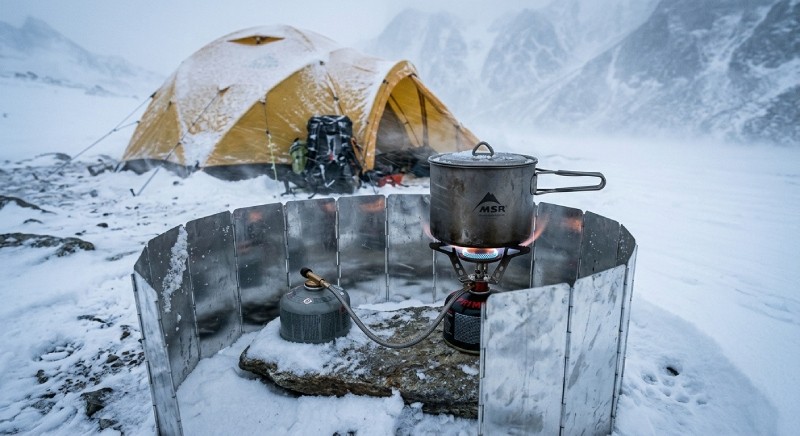
Wind strips heat from the flame and pot, lengthens boil times, and can destabilize or extinguish the flame. Wind affects both combustion efficiency and fuel vaporization indirectly. Combined with cold (already lower vapor pressure), the effect multiplies fuel consumption.
Practical responses: use a stove that accepts a full windscreen (remote canister or liquid-fuel designs work best), cook in a sheltered but still ventilated location, and choose pots with heat exchangers or good retention.
Wind should influence stove selection as much as temperature, not just field setup.
How to Fix a Camping Stove That Won't Work in Cold Weather?
| Symptom | Cause | Solution |
|---|---|---|
| Stove won’t light | Fuel too cold, vapor pressure too low | Warm the canister with body heat only. Switch to a propane-richer blend or liquid fuel for deeper cold. |
| Weak flame | Canister freezing from evaporative cooling or wind | Insulate the canister base, keep it off snow, improve wind protection. A regulated stove helps maintain output longer. |
| Stove shuts off mid-use | Unstable gas flow from low pressure | Warm the fuel source, check orientation on remote systems, clear blockages. Confirm pump pressure and clean the jet on liquid-fuel stoves. |
| Fuel remaining but stove not working | Liquid trapped because it cannot vaporize fast enough | Warm the canister thoroughly; the remaining fuel becomes usable again once vapor pressure recovers. This is not a defect but a vaporization limitation. |
Additional high-frequency cases:
- Morning ignition failure: Canisters left on cold ground overnight lose pressure. Warm them before first light.
- High-altitude startup failure: Lower atmospheric pressure plus cold further reduces vapor pressure. Liquid fuel or pre-warmed regulated systems perform more reliably.
- Intermittent failure: The stove works briefly, then fades as the canister cools during use. Warm the canister between boils and improve insulation and wind protection.
Winter Camping Stove Pre-Use Checklist
Prioritize safety and fuel reliability over weight savings in winter conditions.
Must-do
- Warm the fuel canister with body heat before use.
- Keep the canister insulated and off snow or frozen ground.
- Cook only outdoors with clear ventilation.
Recommended
- Position the stove for maximum wind protection while remaining stable.
- Carry backup waterproof ignition.
- Bring extra fuel beyond calculated needs.
Optional but useful
- Test the complete system in realistic cold conditions before a critical trip.
- Carry a simple repair kit (jet cleaner, spare pump parts) for liquid-fuel stoves.
How to Choose the Best Winter Camping Stove (Final Decision Guide)
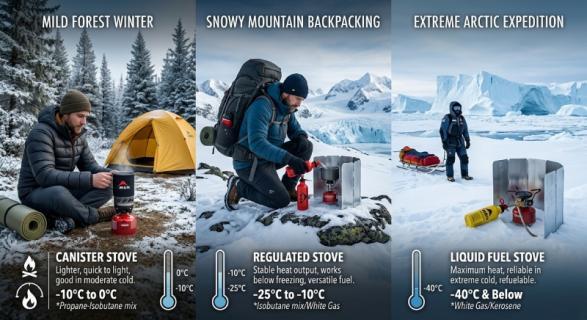
Evaluate these variables together:
| Temperature | Recommended Stove & Fuel |
|---|---|
| 0°C to -5°C | Canister stove with isobutane/propane blend |
| -5°C to -15°C | Regulated or remote canister stove; keep fuel warm |
| -15°C or below | Liquid-fuel (white gas) stove |
- Wind exposure: High wind favors remote-canister or liquid-fuel designs that accept full windscreens.
- Altitude: Higher elevation compounds cold effects on vapor pressure and favors liquid fuel.
- Group size & cooking demand: Solo/light cooking → lightweight canister systems. Group/heavy snow-melting → liquid fuel or multi-burner propane.
- Operational risk tolerance: Backpacking in moderate conditions can accept lower reliability. Expedition or survival-critical trips require near-zero tolerance for failure (liquid fuel).
Match stove and fuel to the lowest temperature, expected wind, altitude, group size, cooking demand, and operational risk tolerance, then add a safety margin. This is a risk-oriented decision, not just a weight or convenience decision.
Frequently Asked Questions
Q1. Is propane better than butane for winter camping?
Yes. Propane maintains usable vapor pressure far lower than butane. Blends that include propane are the practical choice for most backpackers.
Q2. Can I use a camping stove in freezing temperatures?
Yes, if you select the right fuel and stove type and keep the fuel warm. Performance still declines without proper management.
Q3. Why does my stove stop working in cold weather?
Vapor pressure drops. Liquid fuel inside the canister cannot turn into gas fast enough to feed the burner.
Q4. What is the best stove for melting snow?
A liquid-fuel white-gas stove offers the highest reliability for sustained high output in extreme cold.
Q5. Can I warm a gas canister safely in winter?
Yes. Body heat (inside a jacket or sleeping bag) is the recommended and safest method. Never use an open flame or direct heat source that could over-pressurize the canister.
Conclusion
Choosing the best portable gas stove and fuel for winter camping is a risk-oriented decision driven by temperature, wind, altitude, group size, and operational demand. Above -10°C, a regulated canister stove with an isobutane/propane blend handles most trips. Below -15°C or at altitude, a liquid-fuel white gas stove provides the reliability that canister systems cannot sustain.
Always verify performance with your specific stove and fuel combination under realistic cold conditions before relying on it in the field. Prioritize safety and fuel reliability over weight savings, cook only outdoors with clear ventilation, and plan fuel for 2–4× summer consumption.
For buyers sourcing portable gas stoves or camping cookware, CHEFF provides manufacturing solutions with certification support and customization capability tailored to your target markets.